
Cross-Connection Control Software: What California Water Systems Should Require
What backflow and cross-connection control software must track under California's CCCPH: required records, tester checks, notices, and vendor questions.
Short answer: California does not require cross-connection control software, but it does require every public water system to run a recordkeeping system that meets Section 3.5.1 of the Cross-Connection Control Policy Handbook (CCCPH). In California, the right test for backflow software is whether it can hold those records and produce them for the State Water Board on request: two hazard assessments per premises, a full record for each assembly, three calendar years of test and repair results with the tester’s certification number, and backflow incident follow-up. The vendor pages we reviewed sell general test tracking without mentioning the CCCPH, so ask each vendor to show you those records.
Last reviewed November 1, 2026, against the April 21, 2026 revision of the CCCPH. Sources are listed at the end.
This guide is for the people who run a program: cross-connection control coordinators, water system managers, and contract administrators. Exodus Water Services makes one of these products, Exodus Water Compliance, so read the checklist as a set of questions to put to any vendor, including us.
Do you need software at all?
The CCCPH sets the outcome, not the tool. Section 3.1.3(a)(7) says a water system must “develop and implement a recordkeeping system” in accordance with Section 3.5.1. A small system with a few dozen assemblies can meet that with a well-kept spreadsheet and a filing cabinet.
Software starts to earn its place when any of these are true:
- More than one person handles notices, test reports, or customer calls.
- Reports arrive by mail or email and someone retypes them.
- You cannot say today which assemblies are overdue, or which failed tests are past 30 days.
- A hazard assessment finding lives in a different place from the assembly it applies to.
- Pulling the records for one premises takes more than a few minutes.
The records your system must be able to produce
This is the core of the buying decision. Section 3.5.1(a) lists what each public water system must maintain, and Section 3.5.1(b) requires all of it to be available to the State Water Board on request.
| CCCPH 3.5.1(a) | Required record | What to look for in software |
|---|---|---|
| (1) | The two most recent hazard assessments for each user premises | Assessments stored by premises, with history kept when a new one is added |
| (2) | For each assembly: associated hazard or application, location, owner, type, manufacturer and model, size, installation date, serial number | Each of these as its own field, not a free-text note |
| (3) | For each air gap: associated hazard or application, location, owner, as-built plans | Air gaps tracked as devices, with file attachments |
| (4) | Results of all assembly field tests, air gap inspections, and swivel-ell inspections and field tests for the previous three calendar years, with tester name, test date, repair date, and certification number | Certification number required on every report; history retained for at least three calendar years |
| (5) | Repairs, replacements, and relocations for the previous three calendar years | Repair events tied to the assembly |
| (6) | The most current cross-connection tests, such as shutdown or dye tests | A place to store these by premises |
| (7) | User supervisor contact details, training, and qualifications, if one is designated | Contact and document fields at the premises level |
| (8) | Descriptions and follow-up actions for all backflow incidents | An incident log with dates and actions |
| (9) | The current contract or agreement for any contracted program work | Document storage, or a clear place outside the system |
| (10) | The current Cross-Connection Control Plan | Same |
| (11) | Public outreach and education materials for the previous three calendar years | Same |
Items (9) to (11) are documents more than data, and no software writes them for you. Your Cross-Connection Control Plan still has to be prepared and submitted as its own document. Our CCCPH guide covers the wider program.
The workflows software should handle
Records are the minimum. The daily value is in the deadlines the CCCPH attaches to them.
| Rule | CCCPH section | What the software should do |
|---|---|---|
| Assemblies are field tested at least annually | 3.3.3(b) | Show due and overdue assemblies, and allow a shorter interval for high hazard premises |
| Air gaps are visually inspected at least annually | 3.3.3(c) | Track air gaps on the same due-date cycle |
| Testing follows installation, repair, winterizing depressurization, or permanent relocation | 3.3.3(a) | Reset or flag the due date after these events |
| A passing test is received before continuous service to a newly installed assembly | 3.3.3(d) | Flag new assemblies with no passing test |
| Failed assemblies are repaired or replaced within 30 days of notification | 3.3.3(e) | Run a 30-day clock from the failure notice, with room for the extensions your plan allows |
| Testers report an observed backflow incident or unprotected cross-connection within 24 hours | 3.3.3(f) | Give testers a way to report it, and alert staff |
| Testers hold valid certification from a recognized organization | 3.4.1(a) | Check the certification on each report, not just once a year |
| Backflow incidents are reported to the State Water Board and local health agencies within 24 hours of the determination | 3.5.3(a) | Record the determination and notification dates |
| A hazard assessment follows a change of account holder (excluding single-family residences), a new connection, or changed activities | 3.2.1(e) | Prompt a new assessment when these events are logged |
The handbook also lets a water system decide how to enforce. Section 3.1.3(a)(1) requires legal authority to act when a customer does not comply, including at least one of denying or discontinuing service, installing or testing the assembly itself, or otherwise addressing the failure. Notice letters should follow your own rules, so check that the sequence and wording can be changed to match them.
How programs track this work today
There are four common setups. The handbook allows any of them, and Section 3.1.3(a) lets a water system carry out its program directly or by contract, in whole or in part.
| Setup | How it works | Good fit | Watch for |
|---|---|---|---|
| Spreadsheet and files | Staff keep the list and mail the notices | Very small programs | Lost history, retyping, and one person holding all the knowledge |
| Software your staff run | The utility holds the account and staff do the daily work | Systems with office staff assigned to the program | Staff time is still needed; hazard assessments stay with certified people |
| Portal funded by tester fees | Testers pay to file reports; the utility pays little or nothing | Systems that want no software budget | Tester cost and availability; who owns the data if you leave |
| Outsourced program administration | A contractor sends notices, takes customer calls, and runs the records | Systems without staff to spare | You remain responsible, and Section 3.5.1(a)(9) requires a copy of the current contract |
Who pays varies by vendor. BRYCER says its backflow product is funded by fees that testing companies pay per submission, while HydroCorp says its pricing can be split between testers and the utility. Ask for this in writing, because a tester fee can end up in what your customers pay for a test.
One limit applies to all four. Software does not satisfy the staffing rules. Water systems with 3,000 or more service connections must have a program coordinator who is a cross-connection control specialist (Section 3.1.3(a)(2)), and at least one specialist reachable within one hour (Section 3.1.3(c)). Systems with 1,000 or more connections must develop the program in consultation with a specialist (Section 3.1.3(b)).
How to evaluate a vendor
- Inventory your program first. Count premises, assemblies by type, active testers, and notices sent per year. Our free CCCP Readiness Assessment shows the program gaps worth fixing before you pick a tool.
- Bring the 3.5.1 table to the demo. Ask the vendor to open one sample premises and show each record. Skip general claims about being compliant.
- Test the tester’s path. Have a tester you work with file a report on a phone. Note whether an account, an app, or a fee is needed, and what happens with no signal.
- Check the report review step. Ask what stops a bad report: an expired certification, a mismatched serial number, or a duplicate.
- Run a failed test through it. Follow it from failure to notice, repair, retest, and closure, then look at the record it leaves.
- Move a real sample of data. Upload a few hundred rows from your own spreadsheet. Check how errors are shown and whether the upload can be undone.
- Settle the exit. Confirm you can download every list and every report, including history, in a format you can use elsewhere. Section 3.5.1 keeps applying if you change vendors.
Questions most vendor pages do not answer
We reviewed the leading backflow software pages for this guide on November 1, 2026. They describe test tracking and customer notices well, but the ones we read do not mention the CCCPH. Ask directly:
- Which fields map to each item in CCCPH Section 3.5.1(a)?
- Do you recognize all the assembly types in the handbook, including swivel-ells and air gaps?
- Can the failed-test clock follow the extension rules in our plan?
- Where are the State Water Board notification dates for incidents recorded?
- Who owns the data, and what does an export include?
- How do you handle the April 21, 2026 revision of the handbook, and how quickly do you update for the next one?
A gauge calibration check is also worth asking about. The CCCPH text does not set a calibration interval, so check your plan and your water supplier’s rules. If you track it, the software should hold the date.
Reporting systems in Ventura County
Local water suppliers already use different systems, which is why testers working across a region often file in several places.
| Water supplier | How test results are filed | Source |
|---|---|---|
| Ventura County Waterworks Districts 1, 17, 19, 38 | Certified testers submit through SwiftComply | Ventura County Public Works |
| City of Camarillo | Testers submit only through SwiftComply | City of Camarillo |
| Waterworks District 8 (Simi Valley) | Testers file on BSI Online | City of Simi Valley |
| Camrosa Water District | Testers file through its online portal | Camrosa |
The county’s role also changed. Effective July 1, 2025, Ventura County Environmental Health stopped sending notices and accepting test reports, and each water supplier now manages its own program. If your system took on that work and has no tracking in place, this is the gap to close first. Systems in Los Angeles and San Bernardino counties face the same statewide handbook, so the checklist above applies there too.
Where Exodus Water Compliance fits
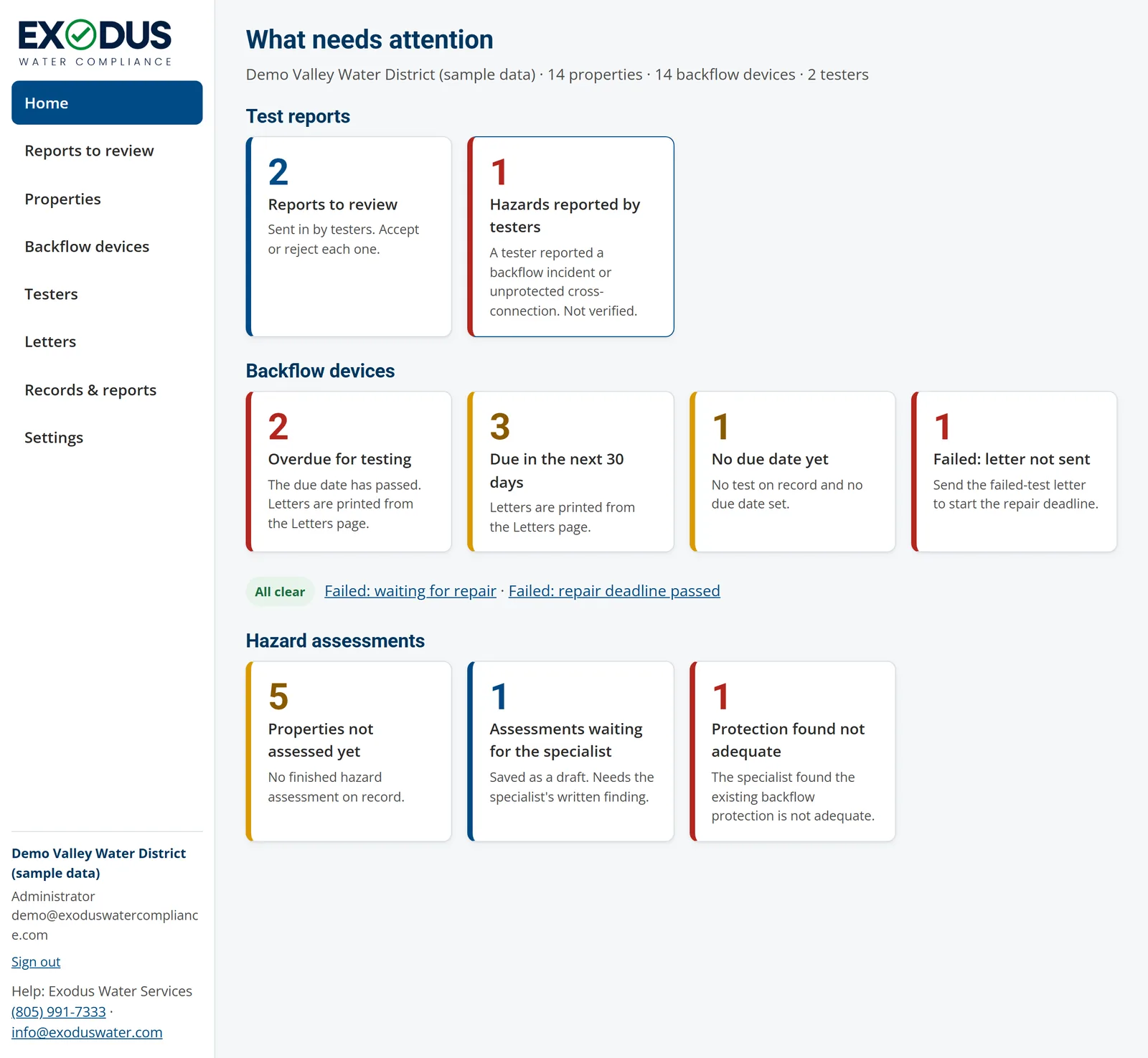
Exodus Water Compliance is the record system behind our cross-connection control programs, built around the CCCPH for California public water systems.
- Assemblies: all ten device types in the handbook, each with the 3.5.1(a)(2) fields and attached photos and paperwork.
- Test reports: each notice letter prints with a QR code, and the tester files from a phone form with no account and no app.
- Review queue: reports are flagged for an expired tester certification, an out-of-date gauge calibration, a first-time tester, a possible duplicate, or mismatched device details.
- Letters: first through final notices, failed test, and shut-off notices, with the next letter proposed for each device.
- Hazard assessments and incidents: guided assessments for the specialist to finish, plus an incident log with the State Water Board notification date.
- Moving in and out: bulk spreadsheet upload with a row-by-row preview and undo, and every list downloads as a spreadsheet.
It keeps records. It does not write your plan or make compliance determinations, which stay with certified specialists. Access is by invitation and arranged system by system. You can run your program on it yourself, or have Exodus administer the program on the same system. Request access or call (805) 991-7333.
Frequently asked questions
Does California require cross-connection control software? No. The CCCPH requires a recordkeeping system that meets Section 3.5.1, but it does not require a particular tool. Software is a choice, and the records are the requirement.
What records must a California water system keep for its backflow program? The two most recent hazard assessments for each premises, detailed records for each assembly and air gap, three calendar years of test and repair results with the tester’s certification number, incident follow-up, the current Plan, any program contract, and three calendar years of outreach materials (CCCPH 3.5.1).
How long do backflow test records have to be kept in California? Results of field tests, air gap inspections, and swivel-ell inspections and tests must be kept for the previous three calendar years, as must repairs, replacements, and relocations (CCCPH 3.5.1(a)(4) and (5)). Your own plan or records policy can require longer.
Does the software replace a Cross-Connection Control Specialist? No. Systems with 3,000 or more service connections must have a coordinator who is a specialist and a specialist reachable within one hour (CCCPH 3.1.3). Hazard assessment findings and plan decisions still need qualified people.
Who pays for backflow software, the utility or the testers? It depends on the vendor. Some charge the utility, some fund the product through per-report fees paid by testers, and some allow a split. Ask for the fee schedule in writing and consider how a tester fee reaches your customers.
Can a contractor run the program on our behalf? Yes. Section 3.1.3(a) lets a water system carry out its program directly or by contract, in whole or in part. The water system must keep a copy of the current contract or agreement (Section 3.5.1(a)(9)).
Can we start with a spreadsheet and move to software later? Yes, if the spreadsheet holds the required fields and you keep the supporting documents. Before moving, clean up serial numbers and locations, because those fields drive matching when reports come in.
Sources
- State Water Board, Cross-Connection Control Policy Handbook page (effective July 1, 2024; revised April 21, 2026)
- State Water Board, Cross-Connection Control Policy Handbook, April 2026 revision (PDF): sections 3.1.3, 3.2.1, 3.3.3, 3.4.1, 3.5.1, and 3.5.3
- Ventura County Environmental Health, Cross-Connection Control and Backflow Prevention
- Ventura County Public Works, Cross-Connection Control and Backflow Prevention
- City of Camarillo, Water Backflow Prevention
- City of Simi Valley, Backflow Prevention
- Camrosa Water District, FAQs